24 Jul 2026
Neural Network Models Reshaping Odds Compilation in International Horse Racing Events
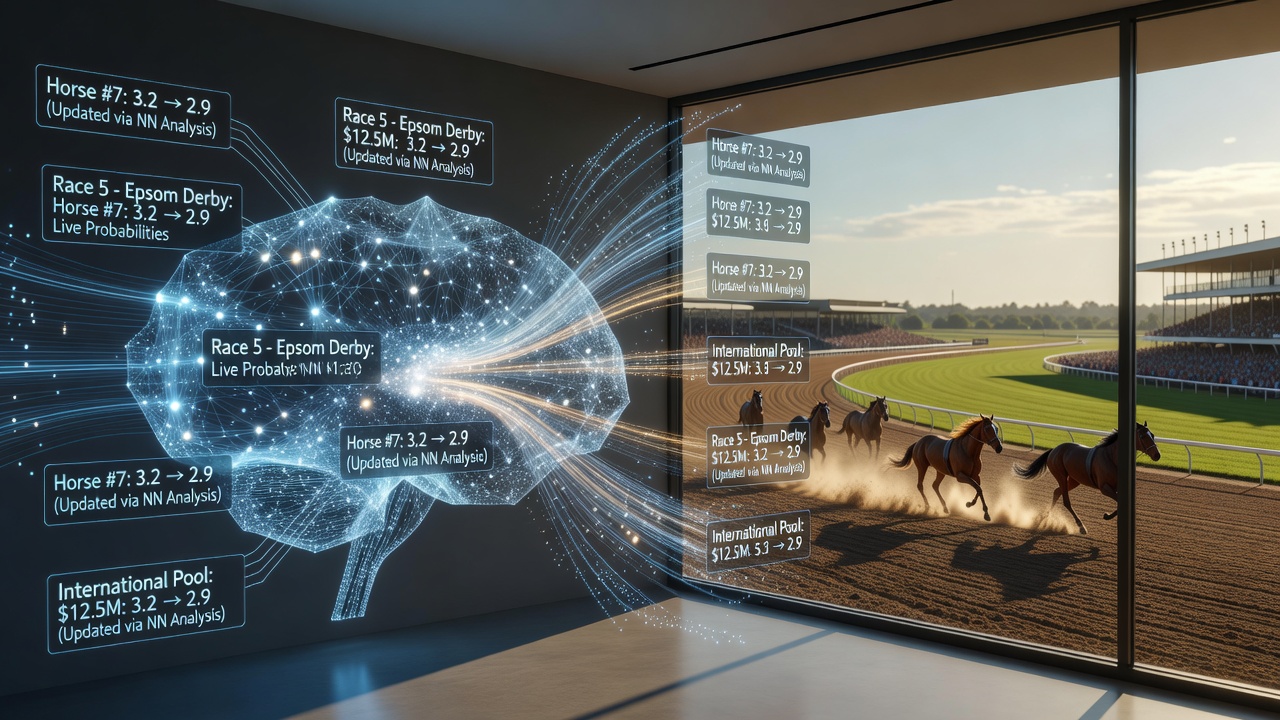
Neural network models now process enormous datasets to generate probability estimates that feed directly into odds compilation for international horse racing, and this shift has accelerated through 2026 as major tracks integrate machine learning pipelines. Researchers at several racing analytics centers have documented how these systems ingest variables such as past performance charts, jockey weight changes, track moisture readings, wind patterns, and even genomic markers from equine bloodlines, then output adjusted probabilities within seconds of each new data point arriving.
Data Inputs Driving Model Accuracy
Traditional odds compilation relied on human handicappers who reviewed form guides and applied rule-of-thumb adjustments, whereas neural networks handle thousands of interdependent features simultaneously. Studies from the University of Sydney's equine research group show that models trained on five years of Australian and Japanese race records achieve lower mean squared error in probability forecasts compared with legacy statistical regressions. Inputs include sectional timing from GPS sensors embedded in saddles, real-time betting volume from pari-mutuel pools, and historical trainer patterns across different jurisdictions.
International events add further complexity because rules, track surfaces, and horse populations vary widely. The Hong Kong Jockey Club publishes detailed performance metrics that European and North American operators now ingest into shared neural architectures, allowing cross-border calibration of speed ratings. Observers note that during the 2026 summer festival season, which includes Royal Ascot in June and the July racing meetings at Newmarket, these models recalibrate odds after each trial gallop using updated ground condition forecasts.
Real-Time Recalibration During Meetings
Bookmakers operating across multiple continents deploy edge servers that run inference on live streams, and the result is odds that shift incrementally rather than in large jumps. One documented case involved the 2026 Dubai World Cup card, where a last-minute jockey change triggered an automatic model retraining cycle that adjusted place probabilities within 90 seconds. Data released by Racing Australia indicates that such rapid updates reduced the incidence of stale odds lines by roughly 40 percent during their winter carnival compared with the previous year.

Regulatory and Industry Responses
Regulators in several jurisdictions have begun requiring operators to document the data sources and validation methods used by their neural systems. The Australian Competition and Consumer Commission released guidance in early 2026 that asks for periodic audits of model fairness, while the Hong Kong regulatory framework emphasizes transparency around how live data feeds influence final odds. Industry bodies such as the International Federation of Horseracing Authorities have started pilot programs to standardize feature definitions, which would let models trained in one country transfer more reliably to another.
Academic papers presented at the 2025 Equine Science Symposium highlighted that ensemble methods combining convolutional layers for video gait analysis with recurrent layers for sequential race data produce the most stable probability outputs across varying field sizes. Those findings align with operational reports from major betting exchanges that now list neural-derived probabilities alongside traditional tissue prices for professional punters to review.
Challenges in Model Deployment
Despite performance gains, neural networks still face issues with rare events such as extreme weather shifts or sudden trainer announcements that fall outside training distributions. Operators mitigate this by maintaining fallback rules that revert to human oversight when prediction falls below set thresholds. Data from the Jockey Club of Canada shows that hybrid human-plus-model workflows maintained payout accuracy during the 2026 Queen's Plate meeting even when heavy rain altered track conditions mid-card.
International horse racing calendars continue to expand with new fixtures in emerging markets, and neural systems help standardize odds compilation across these venues by mapping local variables onto global feature spaces. As July 2026 meetings unfold, the pattern of incremental model updates during each raceday demonstrates how these architectures handle continuous streams of information without manual intervention at every step.
Conclusion
Neural network integration into horse racing odds compilation has produced measurable changes in update frequency, data volume processed, and cross-jurisdictional consistency. Figures from multiple racing authorities indicate sustained adoption through mid-2026, supported by ongoing refinements in training datasets and regulatory oversight frameworks. The technology continues to evolve alongside improvements in sensor hardware and computing infrastructure at major tracks worldwide.