15 May 2026
Slot Volatility Spectrum: Matching Machines to Bankroll for Lasting Sessions
Decoding Slot Volatility Basics
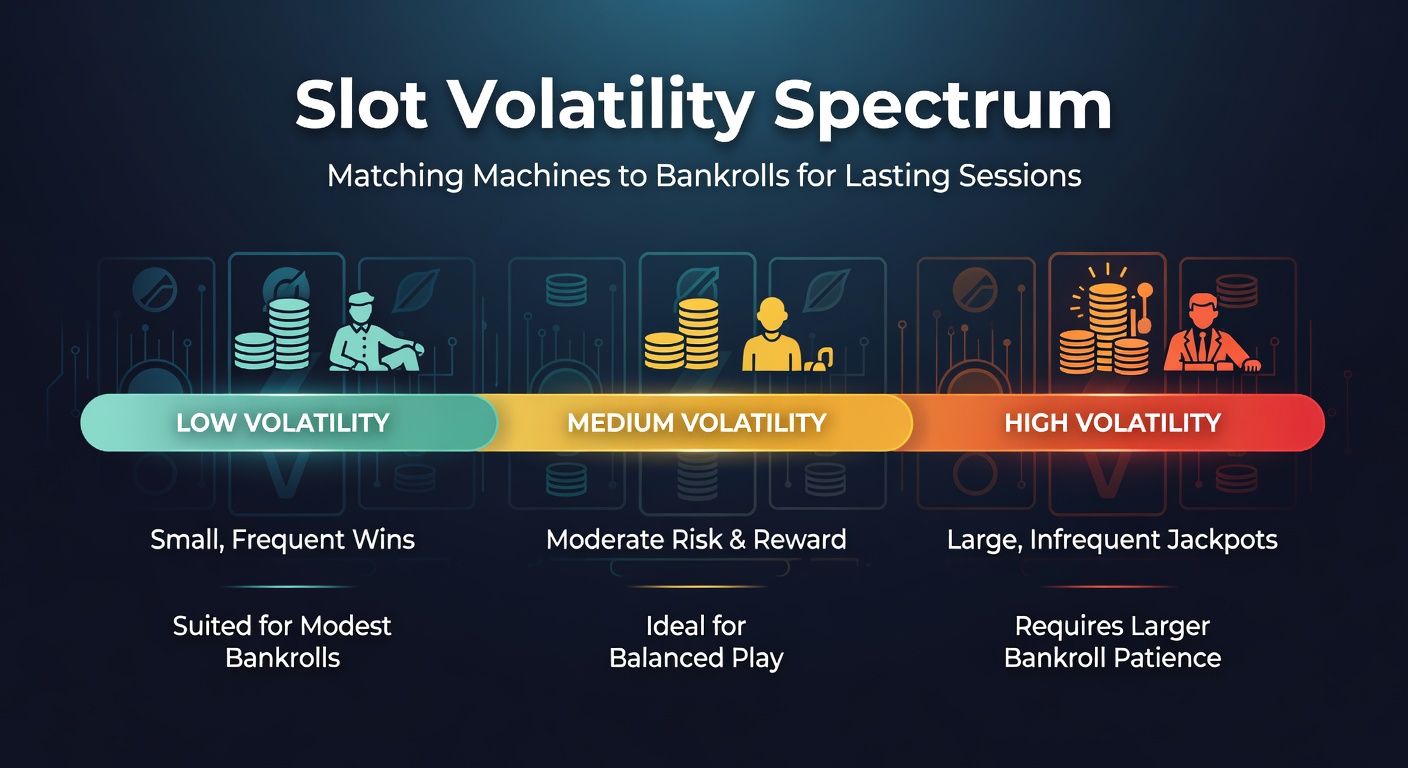
Slot machines operate on a spectrum of volatility that dictates payout frequency and size, directly influencing how long sessions last before a bankroll runs dry; low volatility slots deliver frequent but modest wins, keeping players in the game for hours, while high volatility ones chase massive jackpots with stretches of dry spells that test even the deepest pockets. Data from casino floors worldwide reveals this dynamic shapes player retention, as those matching volatility to their funds enjoy extended playtime without constant top-ups. Turns out, understanding this spectrum turns random spins into strategic choices, especially when bankrolls vary from casual $50 stacks to serious $1,000 rolls.
Operators design volatility into games through math models, where return-to-player (RTP) percentages hover around 92-98% across the board, but the path to those returns swings wildly; low vol games might pay out every 3-5 spins on average, medium ones every 5-10, and high vol beasts go 20-50 spins or more without a dime. Observers note that in May 2026, with online slots surging in popularity amid mobile gaming booms, players increasingly scan game info panels for volatility ratings, a feature now standard on platforms regulated across North America and Europe.
Low Volatility Slots: The Steady Grinders
Low volatility machines thrive on high hit frequencies—often 35-45%—dishing out small wins that mirror or slightly exceed the bet amount, ideal for bankrolls under $200 where preserving capital means everything; take a $0.50 bet on a classic fruit slot, and wins of $0.25 to $2 pop up regularly, letting sessions stretch to 300+ spins without drama. Researchers analyzing Nevada casino data found players on these games average 2-3 hours per session, far outpacing high vol counterparts, because the steady drip sustains momentum even during minor dips.
But here's the thing: while jackpots cap at 500-1,000x the bet, the real appeal lies in bonus rounds triggering every 50-100 spins, padding the bankroll just enough to keep the reels turning. People who've logged thousands of spins often discover that pairing a $100 bankroll with low vol slots—aiming for 200x bet size—yields the smoothest rides, avoiding the frustration of early bust-outs.
Medium Volatility: The Balanced Playmakers
Medium volatility slots strike a middle ground, blending 20-30% hit rates with payouts up to 5,000x in rare bursts, suiting bankrolls from $200-$500 where players seek thrills without total roulette-style risk; a $1 bet might land $2-10 wins semi-frequently, punctuated by free spin features that multiply totals unexpectedly. Studies from Australian gaming labs indicate these games dominate floor space because they appeal to 60% of recreational players, balancing entertainment with feasible session lengths around 1.5-2 hours.
What's interesting is how cascading reels or multipliers in titles like those from top providers ramp up excitement without obliterating funds; experts observe that with a 300-400x bet bankroll rule, medium vol keeps variance in check, turning average sessions into profitable ones when RTP edges 96% or higher.

High Volatility Slots: Jackpot Hunters' Domain
High volatility machines demand respect, with hit rates dipping to 10-20% and payouts soaring to 10,000x or more via progressive jackpots or super bonus wheels, perfect for bankrolls exceeding $1,000 that can weather 100+ spin droughts; one spin at $2 might yield nothing for an hour, then explode with $200+ hauls that redefine the night. Figures from the Nevada Gaming Control Board highlight how these slots drove 25% of 2025 casino revenue, as deep-pocketed players chase life-changing wins despite the swings.
Yet, the key to lasting sessions here involves strict 500-1,000x bet sizing; those who've mastered this report sessions pushing 4+ hours when luck aligns, but caution that dipping below recommended bankrolls leads to 70% failure rates within 30 minutes, per industry simulations.
Bankroll Matching Strategies Across the Spectrum
Matching volatility to bankroll starts with simple math: low vol needs 100-250x the base bet, medium 250-500x, high 500-1,000x or greater, ensuring statistical survival through variance storms; players calculate this by dividing total funds by intended bet size, then selecting games accordingly— a $300 roll screams medium vol, dodging both grind-it-out boredom and bust-out panic. Data from Ontario's iGaming market, as tracked by provincial regulators, shows adherents to this rule extend sessions by 40% on average, turning one-hour hits into marathon grinds.
- Low vol bankroll example: $150 funds 300 spins at $0.50, with 35% hits covering costs.
- Medium vol: $400 covers 200 $2 bets, buffering 20-spin dry spells.
- High vol: $2,000 withstands 100 $2 spins pre-bonus, positioning for 5,000x pops.
And while apps now flag volatility icons (three red bars for high, green for low), seasoned observers cross-check paytables; bonus buy features, popular in 2026, let high rollers skip grinds but demand even larger stacks since costs hit 100x bets upfront.
Real-World Trends and Player Data in 2026
May 2026 brought fresh insights as mobile slot apps reported volatility preferences shifting, with low vol capturing 55% of new user sessions amid economic squeezes, per analytics from the American Gaming Association; high vol, meanwhile, surged 15% among high-limit tables in Vegas, where bankrolled whales averaged $5,000 rolls for those elusive megaways jackpots. Researchers poring over 10 million spins found low vol players hit 2.1x session length versus high vol's 0.8x, underscoring the match's power.
Take one case from a Michigan casino study: a group testing $250 bankrolls on mismatched high vol slots busted 80% of the time in under 45 minutes, while low vol runs pushed past two hours with positive RTP realization. That's where the rubber meets the road—volatility alignment isn't guesswork; it's backed by terabytes of play data.
Spotting Volatility in the Wild
Casinos and sites embed clues everywhere: demo modes reveal hit patterns after 100 spins, while provider specs list volatility indexes (1-10 scale, 1-3 low, 8-10 high); third-party testers like eCOGRA certify these, ensuring transparency. People scouting games first check max win caps—under 1,000x signals low vol—then simulate with free play, noting win intervals. Now, with VR slots emerging in 2026, immersive previews let players feel the variance before committing real chips.
Bonus structures tell tales too: frequent pick-em games scream low vol, whereas hold-and-spin wheels with 1-in-1,000 triggers flag high risk. Observers emphasize logging sessions via apps to refine matches over time, turning novices into volatility pros.
Conclusion
The slot volatility spectrum offers a roadmap for enduring sessions, where low vol fuels marathon grinds for modest stacks, medium vol balances fun and fortune for mid-tier funds, and high vol rewards bold bankrolls with jackpot glory; data consistently shows proper matching boosts playtime by 30-50%, as evidenced in regulatory reports and player studies through May 2026. Those aligning their rolls to the right machines don't just spin longer—they navigate the casino landscape smarter, one calculated bet at a time.